
Garrett Ziss, Age 9, Pennsylvania: Honorable Mention
Hidden Connections
Back in February 2012, my parents and I went to preview a local auction. My Dad found a bronze Theodore Roosevelt plaque hidden under a table. He liked the plaque because he is a Teddy Roosevelt fan. We did not know anything about the plaque so we went back home and did some research on the internet.
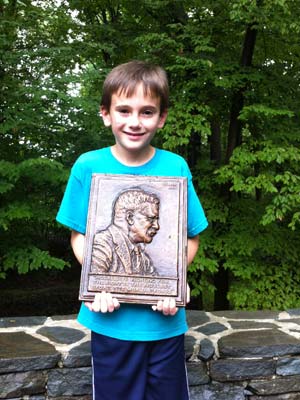
It was designed by James Earle Fraser in 1920 and made by the Decorative Arts League of New York. This didn't mean anything to my parents but it did to me because I am coin collector. I explained to my parents that James Earle Fraser designed the Buffalo Nickel that debuted in 1913. There is also an interesting coin connection between Fraser and Roosevelt because Roosevelt was a coin collector. He is responsible for changing the nation's copper and gold coinage when he was president. He described his actions as "my pet crime."
In his first step, President Roosevelt hired sculptor Augustus Saint-Gaudens (who was James Earle Fraser's teacher) to redesign the $10 (eagle) and $20 (double eagle) gold coins. His double eagle coin has been described as more beautiful than any other US coin ever minted. His coins were minted from 1907 until 1933 when the gold ban was put into action. Saint-Gaudens never saw his coins because he died before the coins made their public debut.
President Roosevelt also commissioned Bela Lyon Pratt (a pupil of Saint-Gaudens) to redesign the $2.50 gold piece (quarter eagle) and $5 gold piece (half eagle). This new design (used on both denominations) debuted in 1908. These gold coins are the only coins in the United States series that are incused, which means sunken relief on a coin. Back when these coins were minted, they were not very popular with the public because their incused design was thought to harbor germs (this was not really true). The quarter eagle and half eagle coin production was stopped in 1929 because of the stock market crash.
President Roosevelt thought the cent was getting a bit aged like the gold coins, so he wanted to redesign that denomination also. In 1908 President Roosevelt went to get his portrait painted by Victor David Brenner. During his visit, he noticed a plaque of President Abe Lincoln. Brenner suggested the thought of putting Lincoln on a cent. President Roosevelt loved the idea so Victor David Brenner changed the cent design in 1909 to the Lincoln cent, which marked the centennial of Lincoln's birth. Lincoln can still be found on the cent today.
Maybe you are wondering if we went back to the auction and bought the Roosevelt plaque. Yes, my dad went to the auction and we were happy when he came home with Teddy Roosevelt. We thought the plaque was too heavy to hang on the wall, so it now rests on the piano top in our dining room so we can be reminded of Theodore Roosevelt and James Earle Fraser and their interesting coin connection.
Bob's comments: Since the Buffalo Nickel is so beloved by American collectors, what a wonderful piece to find! As I read Garrett's essay, I thought about the numismatic plaques I have owned over the years --- but none come close to this beauty! Besides, my best friends are all Teddy Roosevelt fans, so I'm a wee bit jealous. I looked under all the tables in my house, and all I found was an old Red Book --- and I had to leave it there so the table wouldn't rock!