
LOT #983 |
Sold on Mar 28, 2009 for: Not Sold
1876-CC 20C MS64 NGC....
Click the image to load the highest resolution version.
Sold on Mar 28, 2009 for:
Not Sold Description
Legendary 1876-CC Twenty Cent Piece, MS64
Most Celebrated Issue From Carson City
1876-CC 20C MS64 NGC. The introduction of the ill-fated
twenty cent piece occurred at the nexus of partisan politics and
poor planning. Thomas Jefferson's original coinage recommendation
from the mid-1780s envisioned denominations of a half dollar, fifth
of a dollar, tenth dollar, 20th dollar, and 100th dollar or cent.
There was no quarter dollar in the Jefferson scheme. However, as
adopted per the recommendation of Robert Morris, superintendent of
finance for the Continental Congress, the quarter dollar was
introduced instead of the fifth dollar.According to Rusty Goe's The Mint on Carson Street, "For over 80 years, quarter dollars were one of the nation's primary subsidiary coins. They served their purpose well--until a shortage of 1/20th dollars (or half dimes) in the West and parts of the South caused chronic problems in the nation's retail markets. Customers using quarters to pay for items priced at ten cents often received only a dime in return. Merchants claimed to be out of smaller denominations. In saloons all throughout the western states, a glass of beer cost five cents, and well drinks were commonly priced at 12-1/2 cents. Beer drinkers had no problem, but customers imbibing in shots of liquor faced the annoyance of being shortchanged when paying for a drink with a quarter, as bartenders only tendered a dime in change. Obviously many tavern patrons would order two drinks at a time, either being accompanied by a friend or simply accelerating their own inebriation."
On the political front, although earlier attempts to expand domestic uses for silver had met with failure, Western silver mining interests had grown increasingly powerful. They also had a new champion in the form of new Nevada Senator John Percival Jones. A successful silver mine owner, Jones succeeded in 1875 in overseeing passage of a Congressional bill authorizing production of the twenty cent denomination. Production began in 1875, only to cease altogether by 1878.
From the start, the denomination was flawed in concept and execution. It was too close in size to the quarter, and both denominations shared (basically) the same obverse, with similar reverses. Mint officials, sensing the dangers, produced the coin with a plain edge rather than the quarter's reeded edge, a subtlety that--like the raised LIBERTY on the twenty cent--was lost on the public at large. (Fast forward: In 1979 the Mint introduces the Susan B. Anthony dollar, slightly larger than a quarter and with an 11-sided inner rim to aid in distinguishing it. It lasts three years in "circulation," despite a final whimper 20 years afterward.)
The Carson City Mint personnel raced to beat San Francisco to produce the first mintmarked coinage of the denomination in 1875, barely beating their California cousins. Senator Jones received the first 1875-CC twenty cent piece off the presses, and the net mintage for the year totaled an impressive 133,290 coins.
Although the mintage of 1876-CC twenty cent pieces was recorded as 10,000 coins, nearly the entire production was melted in 1877 on order of Mint Director Henry Linderman. Goe notes besides the probable survivors from specimens sent to the Assay Commission, various Mint personnel in Carson City or Philadelphia, including Linderman himself, could have obtained specimens.
The current estimate of surviving examples, including the "Maryland Hoard" of seven to nine pieces discovered in the 1950s, is 16 to 18 coins. The 1876-CC twenty cent piece was known as a special and incredibly rare coin as early as 1893, when Augustus Heaton published his famous Mint Marks pamphlet that changed American numismatics forever.
All known examples, including the present piece, show prominent doubling of the raised LIBERTY on the shield, as well as several of the left-side stars (specifically, stars 2-8 here). We also note the presence of errant parts of a second 8 and 7 buried in the denticles at 6 o'clock, also diagnostic. Generous luster prevails on both sides. The satiny surfaces are lightly kissed with tinges of gold and champagne. For pedigree purposes we mention a small scrape from Liberty's left (facing) arm into the left field nearby. Other contact is unworthy of mention.
Although we have handled specimens of this legendary rarity twice before, it has been nearly a decade since we last offered an example. Coins of this ilk rarely come onto the market, and the present piece may mark the last such appearance for many years to come. In MS64 this piece is one of three so certified at NGC, with four finer. PCGS has graded five MS64 coins, with five finer--although resubmissions and duplications are a distinct possibility in all those figures (2/09).
Although some other issues from the Carson City Mint are now known to be rarer in an absolute sense, the 1876-CC twenty cent has a long-lasting cachet unmatched by any other issue from that fabled and legendary institution.
From The Belle Collection of Carson City Coinage.(Registry values: N1)
Coin Index Numbers: (NGC ID# 23R9, PCGS# 5300, GSID# 5041)
Metal: 90% Silver, 10% Copper
Weight: 5.00 grams
ASW: 0.16oz
Mintage: 10,000
View all of [The Belle Collection of Carson City Coinage ]
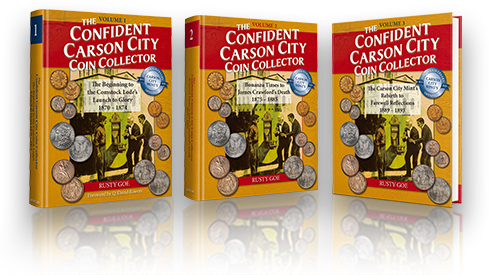
The Confident Carson City Coin Collector
by Rusty Goe
The Carson City Mint’s celebrated legacy — replete with landmark achievements, setbacks, mysteries and tall tales — is covered in exacting detail in Goe’s three-volume set.
by Rusty Goe
The Carson City Mint’s celebrated legacy — replete with landmark achievements, setbacks, mysteries and tall tales — is covered in exacting detail in Goe’s three-volume set.
Auction Info
2009 March Baltimore, MD Signature US Coin Auction #1126 (go to Auction Home page)
Auction Dates
March, 2009
28th-31st
Saturday-Tuesday
Bids + Registered Phone Bidders: 14
Lot Tracking Activity: N/A
Page Views: 19,944
Buyer's Premium per Lot:
15% of the successful bid per lot.
Shipping, Taxes, Terms and Bidding
Terms and Conditions | Bidding Guidelines and Bid Increments | Glossary of Terms | US & World Coin Grading Tutorial
Important information concerning Sales Tax and Resale Certificates. Learn More
Terms and Conditions | Bidding Guidelines and Bid Increments | Glossary of Terms | US & World Coin Grading Tutorial