
LOT #3050 |
Sold on May 3, 2023 for: Sign-in
or Join (free & quick)
1792 H10C Half Disme, Judd-7, Pollock-7, R.4, VG8 PCGS....
Click the image to load the highest resolution version.
Sold on May 3, 2023 for:
$46,800.00
Bid Source: Internet bidder
Description
1792 Half Disme, Judd-7, VG8
America's First Regular Coinage Issue
1792 H10C Half Disme, Judd-7, Pollock-7, R.4, VG8 PCGS. The
2017 book, 1792: Birth of a Nation's Coinage by Pete Smith,
Joel J. Orosz, and Leonard Augsburger is always interesting and
richly informative. At times it is provocative. The authors provide
a thought-provoking analysis of the 1792 U.S. coinage patterns and
a comprehensive analysis of America's first regular issue coinage,
the 1792 half dismes. According to the authors, the 1792 half disme
production bridges the transition from experimental coinage to
establishment of the U.S. Mint. The first 1792 half dismes were
struck in John Harper's cellar, the authors contend a second
production in October of 1792 occurred at the newly opened U.S.
Mint facility:"The records are clear that Thomas Jefferson delivered $75 at the mint to be coined on July 11, 1792. Then on Friday, July 13, he picked up 1500 half dismes that had been coined. According to the Mint Act of April 2, 1792, this was coinage and it was legal tender. In that one week in July, Rittenhouse asked permission to strike coins, the president approved, a deposit of silver was made, coins were struck and delivered to the depositor. From this evidence, it is clear that the 1500 "first strike" half dismes produced in July were regular issue coins."
Regarding the "second strike," the authors say:
"Thus there are two potential periods for the striking of half dismes, July of 1792 and October of 1792. Previous authors have taken a position on one side of the issue but seldom considered both as a possibility. Our recent studies of the die states for 1792 half dismes reveal that later strikes are from dies that show rust or spalling on the surface. Rust pitting would not occur in just three days in July and indicates that the dies were out-of-service in humid conditions for a period of time. This supports the concept that the half dismes were struck on two separate occasions."
In practical terms, the 1792 half dismes served as patterns and regular coinage as well as prototypes. The total official production is unknown, although an estimated total mintage of 2,000 to 2,400 pieces seems a reasonable guess. 1792: Birth of a Nation's Coinage documents 166 specimens that survive, although a few more pieces (including the present coin) have appeared since publication of that book. Accounting for unrecorded institutional holdings and undocumented or unrecognized pieces in old collections, perhaps as many as 250 half dismes survive.
The example in this lot -- although not previously documented -- is an original and richly toned coin. A thin, linear planchet flaw runs from the upper-left rim across Liberty's forehead to the hair. As always for 1792 half dismes, the coin is struck with a medal turn. Here, the coin shows the reverse slightly rotated counterclockwise in relation to the obverse. The obverse is surprisingly well-defined for the grade, while the upper reverse is weak. Attractive, dappled shades of bluish gray toning lighten to silver-gray in the centers. Ownership of a 1792 half disme in any grade is the cornerstone of a well-formed collection -- America's first regular coinage, from the earliest days of the U.S. Mint.
From The Stephenville Collection. (Registry values: P9)
Coin Index Numbers: (NGC ID# 22ZS, PCGS# 11020, Greysheet# 240963)
View all of [The Stephenville Collection. ]

Auction Info
2023 May 3 - 7 CSNS US Coins Signature® Auction #1359 (go to Auction Home page)
Auction Dates
May, 2023
3rd-7th
Wednesday-Sunday
Bids + Registered Phone Bidders: 16
Lot Tracking Activity: N/A
Page Views: 962
Buyer's Premium per Lot:
20% of the successful bid per lot.
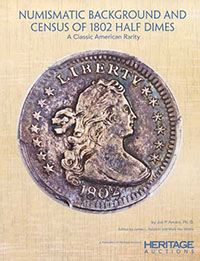
Numismatic Background and Census of 1802 Half Dimes: A Classic American Rarity
This 64-page book cites mintage and rarity estimates by prominent numismatists and documents the currently known 1802 half dime appearances. Each of the 32 documented examples includes an enlarged obverse/reverse photograph, the author's assigned grade, the provenance of each coin, auction prices realized or dealer fixed asking price, and a unique serial number for each specimen that will facilitate retrieval for research, cataloging, or price-information purposes. Reserve your copy of this remarkable volume for just $29.95 today.
This 64-page book cites mintage and rarity estimates by prominent numismatists and documents the currently known 1802 half dime appearances. Each of the 32 documented examples includes an enlarged obverse/reverse photograph, the author's assigned grade, the provenance of each coin, auction prices realized or dealer fixed asking price, and a unique serial number for each specimen that will facilitate retrieval for research, cataloging, or price-information purposes. Reserve your copy of this remarkable volume for just $29.95 today.
Shipping, Taxes, Terms and Bidding
Terms and Conditions | Bidding Guidelines and Bid Increments | Glossary of Terms | US & World Coin Grading Tutorial
Important information concerning Sales Tax and Resale Certificates. Learn More
Terms and Conditions | Bidding Guidelines and Bid Increments | Glossary of Terms | US & World Coin Grading Tutorial