
LOT #3671 |
Sold on Jan 12, 2023 for: Sign-in
or Join (free & quick)
1873-CC 10C No Arrows MS65 PCGS....
Click the image to load the highest resolution version.
Sold on Jan 12, 2023 for:
$3,600,000.00
Bid Source: Internet bidder
Description
1873-CC No Arrows Seated Dime, MS65
Unique in the Federal Series
Famous Carson City Ultimate Rarity
1873-CC 10C No Arrows MS65 PCGS. Ex: Eliasberg-Battle Born
Collections. The late-February 1873 mintage of 12,400 1873 No
Arrows dimes must have seemed like business as usual for Carson
City Mint Director Henry F. Rice. He took five examples from the
mintage and sent them to the Philadelphia Mint for testing in
compliance with the Assay Commission statute, also sending required
quantities of the Seated half dollars and Seated dollars struck in
Carson City the same week. Possibly, he sent samples to the San
Francisco Mint and to Mint Director Henry R. Linderman as well.
Soon after, the Coinage Act of 1873 required all "old style" No
Arrows dimes to be melted. 150 years later, there is no way to say
for sure what happened to the pyx coins. What we do know is that
one Gem example survives today, and no others have been seen in all
those years. The present coin is the sole survivor and is unique
for its type, date, and mint in the U.S. regular series. As Rusty
Goe says in his recent reference, The Confident Carson City Coin
Collector, Volume II, "The uniqueness of this coin must sink
in."Only two other issues are accorded the honor of being unique among all U.S. coins, those being the unique 1870-S half dime and the unique 1870-S three dollar gold piece. Anyone who wants to achieve a collection of "every date and mint in every metal of United States coins" must acquire the 1873-CC No Arrows dime as well as the 1870-S half dime and 1870-S three dollar gold to complete such a set. Likewise, those who want to build a full set of Carson City coinage -- 111 pieces -- must have the unique 1873-CC No Arrows dime to complete that set. Only two collectors have done it so far: Louis E. Eliasberg, Sr. and the Battle Born set collector.
To understand the scope, it is useful and enlightening to track who has owned the 1873-CC No Arrows dime, and when.
1878 -- John Swan Randall
John Swan Randall is perhaps better known for purchasing the Randall Hoard of large cents. His collection was sold at Edward Cogan's May 1878 auction conducted by Bangs & Co. of New York. There, Cogan described the 1873-CC No Arrows dime as "1873 Old style. C.C. Mint. Fine impression." In those days, Fine impression was synonymous with Mint State (or so) and "Old style" meant Without Arrows.
.
1900 to 1908 -- DeWitt S. Smith
John Swan Randall's ownership of an 1873-CC No Arrows dime contradicts an age-old suspicion that the unique dime was part of William H. Woodin's famous exchange of two 1877 Half Unions for a cache of patterns, acquired from the Bureau of the Mint. DeWitt S. Smith's ownership of the coin in the early 1900s reinforces the theory that the unique 1873-CC No Arrows dime did not come from Woodin's exchange with the Mint. Clapp's note book shows "DeWitt Smith has one" and an entry in Dr. Thomas P. Hall's ledger says an 1873-CC Old style dime was "Sold to DeWitt S. Smith Esq. Dec. 1900."
Approximately 1908 to 1915 -- William H. Woodin, Henry O. Granberg
H.O. Granberg had a working relationship with William H. Woodin. Edgar H. Adams wrote in the October 1991 Numismatist (page 367) that Granberg acquired DeWitt Smith's silver coin collection sometime after Smith's death in 1908. The Goe reference surmises Woodin assisted in the sale of Smith's collection. Later, Granberg exhibited the 1873-CC No Arrows dime at the 1914 ANA Exhibition. The cataloger wrote "Only specimen known."
1915 -- Rudolph Kohler
Wayte Raymond offered the Woodin-Granberg 1873-CC No Arrows dime in his May 1915 Catalogue of the Superb Collection of United States Coins Belonging to a Prominent American. There, the coin was described as:
"1873 Without Arrows. Uncirculated with mint lustre. Of the greatest rarity, and we believe unique, as we cannot find a record of any other specimen. The rarest and most important coin in the mint mark series."
Sold as lot 580, it went to a floor bidder named Rudolph Kohler, who owned a nearby coin shop on 5th Avenue in New York City. Many researchers suspect he acted as an agent for an out-of-town buyer.
1915 to 1933 -- Waldo C. Newcomer
Waldo C. Newcomer assembled one of the greatest collections ever, and held the 1873-CC No Arrows dime for 18 years. Facing economic ruin of his Baltimore banking business during the Great Depression, Newcomer arranged to have B. Max Mehl sell his collection.
1933 -- B. Max Mehl
An enterprising Texas coin dealer, B. Max Mehl sold the outstanding Newcomer collection in bits and pieces by private treaty. Newcomer's entire gold collection went to "Colonel" E.H.R. Green, while his complete dime collection was sold by Mehl to the Cincinnati, Ohio insurance executive, Charles M. Williams.
1933 to 1950 -- Charles M. Williams
In a quiet transaction with B. Max Mehl, Charles M. Williams acquired many of Newcomer's silver coins. He held the 1873-CC No Arrows dime for 17 years. Williams undoubtedly knew the coin was extremely rare and appreciated its unique stature. Hidden from view, the coin remained little-known and undervalued. Some collectors even doubted its existence.
1950 -- Sol Kaplan and James Kelly
Sol Kaplan was a dealer from Charles M. Williams home city of Cincinnati, Ohio. Williams negotiated a sale of his collection with Sol Kaplan and Numismatic Gallery, run by Abe Kosoff and Abner Kreisberg. Williams preferred anonymity, so the sale of his collection used a famous Hollywood name and was billed as the Adolphe Menjou Collection of United States Coins. Abe Kosoff recognized the star power of the 1873-CC Without Arrows dime:
"1873. Without arrows. A beautiful and superb gem this excessively rare coin is among the rarest of all United States coins, not excluding any of the better known rarities, such as the 1804 Dollar or the 1913 Nickel, etc. In fact, these coins have been offered several times in the past few years. When was the 1873, no arrows, dime of Carson City offered last? The World's Greatest Collection of dimes was complete -- except for this one dime. Atwater didn't have one. Higgy didn't have one. You'll have to search far and wide to find another. To own this gem is to own a coin the equal of which will probably never appear. With all due respect to estimates of others for a coin they may never have seen, we will predict that this specimen will bring (and it's still a bargain!) $1,000.00"
Louis E. Eliasberg, Sr. needed the 1873-CC No Arrows dime to complete his complete set of federal coins issued between 1792 and 1950. Sol Kaplan and James Kelly bid against him, driving the bidding to $3,650 before Eliasberg dropped out.
1950 to 1996 -- Louis E. Eliasberg, Sr. and family
Accepting that the coin is both his nemesis and his ultimate prize, Louis Eliasberg, Sr. patiently waits while Sol Kaplan fails to recoup the high price he paid for the one coin Eliasberg lacked. Five months later, they settle on a price of $4,000 for the coin.
1996 to 1999 -- Waldo E. "Pat" Bolen
Some 16 years later, the 1873-CC No Arrows die achieves the recognition Abe Kosoff foretold, selling for $550,000 in the May 1996 Eliasberg Collection auction. Illinois bubble gum machine manufacturer Pat Bolen is the successful buyer.
1999 to 2004 -- Jay Parrino
Another world record is set when Heritage sells the unique Carson City dime in 1999 as part of an 11-piece 1873 Carson City date set (silver and gold) assembled by Pat Bolen. Jay Parrino buys the dime.
2004 -- Rusty Goe
Another world record is set by Rusty Goe's purchase of the unique dime at $891,250.
2004 to 2012 -- Battle Born collector
Rusty Goe sells the 1873-CC No Arrows dime to the Battle Born collector in 2004. Eight years later, it shatters the million dollar barrier realizing $1.84 million.
January, 2023 -- The Prestwick Collection, Part II (our consignor)
The present coin, over 10 years since its last appearance.
The unique 1873-CC dime is sharply struck. Its satiny luster glows softly on both sides, which are draped in an even layering of golden-brown and auburn patina with occasional blue accents. Die polishing lines are noted on the figure of Liberty, and a die crack runs prominently through the mintmark. This same reverse die was used to strike the 1873-CC With Arrows dimes as well as the 1874-CC pieces. The only abrasions of consequence are a pair of repeating marks in the lower reverse field below the M in DIME, these possibly incurred during the minting process.
In all our years in the auction business, we can name very few more prestigious coins that have passed through our hands. Added to the obvious importance of the coin's unique stature is the allure of the Carson City mintmark, with coins from this mint being among the most romantic, storied, and highly collected in all of U.S. numismatics. This example is unique in the Seated dime series and is the greatest Carson City rarity -- the ultimate key, impossible to replace or ignore. With the current interest in Carson City issues and because the 1873-CC No Arrows is the missing link to many collecting disciplines, this coin is sure to elicit many bold bids.
From The Prestwick Collection, Part II. (Registry values: P10)
Coin Index Numbers: (NGC ID# 27DA, PCGS# 4661, GSID# 4124)
Metal: 90% Silver, 10% Copper
Weight: 2.49 grams
ASW: 0.07205oz
Mintage: 12,400
View all of [The Prestwick Collection, Part II ]

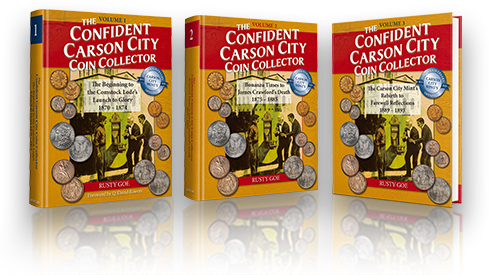
The Confident Carson City Coin Collector
by Rusty Goe
The Carson City Mint’s celebrated legacy — replete with landmark achievements, setbacks, mysteries and tall tales — is covered in exacting detail in Goe’s three-volume set.
by Rusty Goe
The Carson City Mint’s celebrated legacy — replete with landmark achievements, setbacks, mysteries and tall tales — is covered in exacting detail in Goe’s three-volume set.
Auction Info
2023 January 11 - 15 FUN US Coins Signature® Auction #1356 (go to Auction Home page)
Auction Dates
January, 2023
11th-15th
Wednesday-Sunday
Bids + Registered Phone Bidders: 44
Lot Tracking Activity: N/A
Page Views: 10,678
Buyer's Premium per Lot:
20% of the successful bid per lot.
Shipping, Taxes, Terms and Bidding
Terms and Conditions | Bidding Guidelines and Bid Increments | Glossary of Terms | US & World Coin Grading Tutorial
Important information concerning Sales Tax and Resale Certificates. Learn More
Terms and Conditions | Bidding Guidelines and Bid Increments | Glossary of Terms | US & World Coin Grading Tutorial