
LOT #5821 |
Sold on Apr 24, 2014 for: Sign-in
or Join (free & quick)
1870-CC $20 AU50 PCGS. Variety 1-A....
Click the image to load the highest resolution version.
Sold on Apr 24, 2014 for:
$305,500.00
Bid Source: Internet bidder
Description
1870-CC Liberty Double Eagle, AU50
First and Rarest Carson City Twenty
Winter Condition Census Example
1870-CC $20 AU50 PCGS. Variety 1-A. Among regular-issue
Liberty double eagles, the rarity of the 1870-CC is surpassed only
by the ultra-rare 1861 Paquet Reverse, the famous 1856-O, and the
low-mintage 1882 and 1886 issues. It is by far the rarest twenty
dollar gold piece from the fabled Carson City Mint. Heritage
Auctions is pleased to offer this attractive AU50 specimen, a
Condition Census example, and one of the most important lots in
this sale.The discovery of the Comstock Lode in 1859 spurred the development of the region around Carson City, a settlement founded the year before by New York native Abraham Curry. The Comstock Lode was one of the greatest finds of silver and gold ever discovered in the United States, and miners flocked to the area in great numbers from 1859 until the late 1870s, during its years of greatest production. The United States established a mint in Carson City in 1870, with Abraham Curry as Superintendent, to take advantage of that settlement's proximity to the mines.
As is usually the case with new branch mints, operations did not run smoothly the first few years and mintages were quite small. Only 3,789 Liberty double eagles were struck at Carson City in 1870, with two die varieties known for the date. The present coin represents Variety 1-A, with the mintmark centered over the right upright of the N in TWENTY. The coins were released into circulation at the time of issue and none were saved for numismatic purposes. As a result, no Mint State specimens are known to collectors today.
In later times, when the proliferation of numismatic references made mintage statistics common knowledge, collectors would cull low-mintage issues from circulation shortly after their release. No such references existed in 1870, and collectors generally considered mintmark issues unimportant at the time. The usual practice was to complete a date run of a particular series, saving just one specimen of each date, without regard to the mint of issue. It was only after 1893, when Augustus Heaton published his landmark treatise on mintmarks, that collecting coins by date and mintmark varieties became popular. Until the rarity and importance of many mintmark issues became public knowledge, most collectors simply updated their collections every year by ordering proof sets from the Philadelphia Mint.
In the case of the double eagle denomination, the high face value of each coin also mitigated against forming an extensive date and mintmark collection. To the average person, twenty dollars was a great deal of money in 1870. Tying up so much money in the pursuit of a hobby was not practical or desirable. After all, the double eagle denomination was only 20 years old in 1870. The denomination had experienced only one change in design at that point, the addition of the motto IN GOD WE TRUST in 1866. The Liberty double eagles seemed commonplace and numismatically uninteresting to collectors of the 1870s, like Roosevelt dimes of the 1990s would be to collectors today, but with a much higher economic outlay required to collect them. Even after collecting mintmarks became popular, only a few wealthy collectors, like Virgil Brand and John M. Clapp, could afford to systematically collect double eagles.
Ironically, it was Franklin Roosevelt's Gold Recall of 1933 that finally made collecting large denomination gold coins popular in this country. Astute collectors, like Louis Eliasberg and Dr. Charles W. Green, realized that collecting gold coins was one of the few legal ways to stockpile a significant amount of gold in the United States, and double eagles were the best option for such an investment. By the mid-1940s, double eagles were established as a popular collecting discipline among wealthy numismatists. Unfortunately, all examples of the 1870-CC Liberty twenty had been circulating for 70 years by then, and the small mintage had been nearly wiped out by attrition.
One of the earliest auction appearances of the 1870-CC was in lot 688 of the Charles W. Cowell Collection (B. Max Mehl, 11/1911). Cowell was a resident of Denver, and he accumulated many coins from the Western mints, including a full set of Carson City ten dollar coins and an impressive collection of Territorial gold pieces. Like most collectors of the time, he did not systematically collect double eagles, and had only three Carson City twenties in his collection, including the 1870-CC piece in lot 688:
"1870 First $20.00 gold piece of this mint. Fine. Rare."
Cowell had been collecting for forty years at the time his collection was sold. He probably rescued the 1870-CC double eagle in his collection from circulation near the time of issue and saved it for its novelty value. It was only through circumstances such as these that any 1870-CC double eagles survived at all over the years. The issue is quite rare today, as PCGS and NGC have combined to certify only 67 coins in all grades between them (3/14). The population data is skewed by resubmissions and crossovers, as well. Experts estimate the surviving population of the 1870-CC double eagle at 35-50 examples in all grades and conditions.
The present coin is one of the finest survivors. When Doug Winter published his Gold Coins of the Carson City Mint in 2001, this coin was tied with two other specimens for the number one spot in his Condition Census. A number of high-quality coins have been certified since then, but this piece still qualifies as one of the nicest available examples. Our roster below lists all the high-grade specimens we are aware of. The design elements of this coin are well-detailed, with a touch of softness on the hair and obverse stars, as always seen on this issue. The vivid orange-gold surfaces show highlights of red and green, with prooflike luster in sheltered areas. The expected number of minor abrasions are present, including two short parallel scratches in the left obverse field that act as pedigree markers. Altogether, the coin offered here is one of the most attractive specimens of this historically important issue.
Roster of High-Grade 1870-CC Double Eagles
1. AU58 NGC. The finest-known specimen, recently discovered and stolen during a Brinks transport soon afterward.
2. AU55 NGC. Baltimore Auction (Bowers and Merena, 3/2009), lot 3909, realized $414,000.
3. AU53 PCGS. Doug Winter; Nevada collection; Universal Coin and Bullion; Isaac Edmunds Collection (Bowers and Merena, 6/2002), lot 2371; FUN Signature (Heritage, 1/2004), lot 3129, realized $368,000; Bently Collection (Heritage, 3/2014), lot 30435.
4. AU53 NGC. Denver Signature (Heritage, 8/2006), lot 5645, realized $359,375; Philadelphia ANA Sale (Stack's Bowers, 8/2012), lot 11039, realized $345,000.
5. AU53 NGC. Long Beach Signature (Heritage, 9/2003), lot 8296; Pre-Long Beach Sale (Ira and Larry Goldberg, 5/2010), lot 1712; Chicago ANA Sale (Stack's Bowers, 8/2011), lot 7762.
6. AU50 PCGS. Lee Minshull and Casey Noxon; James E. Haldan Collection (Sotheby's, 6/1996), lot 146; Universal Coin & Bullion; private collection; the present coin.
7. AU50 PCGS. FUN Signature (Heritage, 1/2014), lot 5541, realized $329,000.
8. AU50 PCGS. Classics Sale (American Numismatic Rarities, 1/2004), lot 546.
9. AU50 NGC. Richmond Collection (David Lawrence, 7/2004), lot 2288.
10. AU50 Cleaned, Uncertified. Baltimore Auction (Bowers and Merena, 2/2008), lot 2749.
11. AU50 Details ANACS. New York Signature (Heritage, 2/2014), lot 5418, realized $164,500.
From The Collection of Donald E. Bently, sold for the benefit of the Bently Foundation.(Registry values: N14284)
Coin Index Numbers: (NGC ID# 26A8, PCGS# 8958, Greysheet# 9911)
Weight: 33.44 grams
Metal: 90% Gold, 10% Copper
Note for clients in the European Union: This lot is considered by the European Union to be “investment gold”. We believe that it meets the criteria established in Article 344(1), point (2) of Council Directive 2006/112/EC and thus should be exempt from import VAT regardless of the selling price. Any questions or concerns about VAT should be addressed to your accountant or local tax authority.
View all of [The Collection of Donald E. Bently, sold for the benefit of the Bently Foundation ]

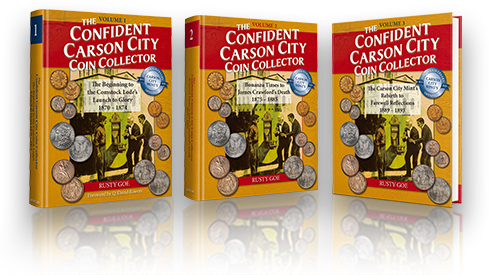
The Confident Carson City Coin Collector
by Rusty Goe
The Carson City Mint’s celebrated legacy — replete with landmark achievements, setbacks, mysteries and tall tales — is covered in exacting detail in Goe’s three-volume set.
by Rusty Goe
The Carson City Mint’s celebrated legacy — replete with landmark achievements, setbacks, mysteries and tall tales — is covered in exacting detail in Goe’s three-volume set.
Auction Info
2014 April 23 - 27 CSNS US Coin Signature Auction - Chicago #1204 (go to Auction Home page)
Auction Dates
April, 2014
23rd-27th
Wednesday-Sunday
Bids + Registered Phone Bidders: 15
Lot Tracking Activity: N/A
Page Views: 1,994
Buyer's Premium per Lot:
17.5% of the successful bid per lot.
Shipping, Taxes, Terms and Bidding
Terms and Conditions | Bidding Guidelines and Bid Increments | Glossary of Terms | US & World Coin Grading Tutorial
Important information concerning Sales Tax and Resale Certificates. Learn More
Terms and Conditions | Bidding Guidelines and Bid Increments | Glossary of Terms | US & World Coin Grading Tutorial