
LOT #3441 |
Sold on Feb 27, 2025 for: Sign-in
or Join (free & quick)
1870-CC $20 AU53 NGC. Winter 1-A....
Click the image to load the highest resolution version.
Sold on Feb 27, 2025 for:
$588,000.00
Bid Source: Internet bidder
Description
1870-CC Liberty Double Eagle, AU53
First-Year, Low-Mintage Issue
Rarest Type Two Twenty
Condition Census Example
1870-CC $20 AU53 NGC. Winter 1-A. The 1870-CC is a classic
rarity in the Liberty double eagle series, from the first year of
coinage operations at the famous Carson City Mint. The 1870-CC
double eagle claims the lowest mintage of the Carson City series,
with only 3,789 examples coined, and the survival rate was
decidedly low. Recent estimates of the surviving population for the
issue include Rusty Goe's appraisal of 55 to 65 examples in all
grades, PCGS CoinFacts' figure of 40 to 50 specimens all told, and
NGC's tally of 35 to 45 coins extant. The two leading grading
services have combined to certify a total of 80 examples between
them, obviously including a number of resubmissions and crossovers
(1/25). In his Guide Book of Double Eagle Gold Coins, Q.
David Bowers notes:"In terms of famous double eagles, the 1870-CC is near the top of the list, and among those made in Carson City it is first and foremost. This is the first year of issue, the lowest mintage, and the rarest variety--three important aspects wrapped up in one, to which can be added its status as the rarest of all Type 2 double eagles."
High-grade examples of the 1870-CC are especially elusive, and the issue is unknown in Mint State. Carson City specialist Rusty Goe calls the 1870-CC the "Queen of Carson City gold coins." Heritage Auctions is privileged to present a Condition Census example of this 19th-century gold rarity in this important offering.
Mintage and Distribution
Discovery of vast deposits of silver and gold in Nevada's Comstock Lode convinced Congress to establish a new coin factory in the territory in the early 1860s. Congress passed the Nevada Territory Mint Act in 1863, with the bustling business hub of Carson City chosen as the site of the new branch mint. After many delays in acquiring equipment, hiring personnel, and construction of the building, the Carson City Mint opened its doors for business on January 8, 1870.
The new facility first struck silver dollars, then eagles, and half eagles, before double eagle production was commenced about March 10. Unfortunately, bullion deposits remained small throughout the early months, because the government had neglected to provide the Carson City Mint with a large bullion fund to pay depositors for their bullion promptly. Many depositors had to wait for their bullion to be coined before receiving payment, which could involve a considerable delay. As a result, many local miners chose to ship their bullion to the San Francisco Mint for coinage, where prompt payment was available. Consequently, deliveries of double eagles remained small throughout the year, with 1,332 pieces delivered in March, 398 coins in April, 1,137 examples in May, 462 specimens in June, and a final delivery of 460 coins in August. Among business-strike Liberty double eagles, only three dates from the New Orleans Mint and five from the Philadelphia facility can claim a lower production total than the 1870-CC, at a meager 3,789 pieces.
In addition to the small bullion deposits, the Carson City Mint experienced some unexplained technical difficulties in the production of the 1870-CC. In The Confident Carson City Coin Collector, Rusty Goe reports:
"Technical problems appear to have occurred, possibly during the first runs of those coins through the presses or in the limited subsequent strikings, because not one example survives today that looks as if it was struck perfectly."
No explanation for the striking problems has been found, but it is worth noting that Carson City Mint Superintendent Abraham Curry wrote to Mint Director James Pollock on May 4,1870 requesting:
"Will you please forward as soon as practicable two obverse dies (heads) for twenty dollar pieces?"
It seems likely that this request was in response to some damage that occurred to the obverse die, as there should have been no need for more than one die pair to strike the small mintage of double eagles in 1870. Two die varieties are known for the 1870-CC, with both varieties appearing with about equal frequency today. The present coin represents the Winter 1-A variety, with the 1 in the large date positioned about halfway between the bust and the dentils and the mintmark centered over the upright of N in TWENTY.
Despite the small mintage and less-than-sterling quality of the coins, the 1870-CC was eagerly accepted in the regional economy and the citizens of Nevada were justifiably proud of the products of their "hometown" mint. Superintendent Abraham Curry reportedly promised to send the first double eagle struck at the new facility to President Ulysses S. Grant, but it is uncertain if he followed through with that plan. Unlike many double eagle issues from the other Mints, the 1870-CC was seldom used in foreign trade and repatriations from overseas holdings have been few and far between over the years. The Condition Census for the issue consists of coins that grade AU50, or better (see the listing of high-grade examples below).
The 1870-CC Double Eagle in the 19th and Early 20th Century
The small mintage of double eagles was released into circulation at the time of issue and no high-quality examples were saved for numismatic purposes. There was little numismatic interest in branch mint issues of any denomination before Augustus Heaton published his landmark treatise Coinage of the United States Branch Mints in 1893. Heaton specifically mentioned the 1870-CC double eagle as a rare issue, but interest in collecting large denomination gold coins was still slow to develop, as few 19th century collectors could afford to set aside extensive date and mintmark runs of twenty dollar coins for their collections. The few wealthy collectors who could afford to collect high denomination gold coins preferred to update their collections by ordering gold proof sets from the Philadelphia Mint every year, eschewing the business-strike branch mint issues. Accordingly, even in the early 20th century, examples of the 1870-CC brought only modest premiums on the rare occasions when they were publicly offered. An early auction appearance of the 1870-CC was in lot 688 of the Charles W. Cowell Collection (B. Max Mehl, 11/1911), "1870 First $20.00 gold piece of this mint. Fine. Rare." The lot realized $24.50, a typical price for the time.
1870-CC Becomes a Branch Mint Icon in Later Years
The situation began to change after the Gold Recall of 1933 took effect. Shrewd financiers, like Louis Eliasberg and Charles W. Green, realized that collecting large denomination gold coins was one of the few legal opportunities to invest in gold after the Recall, and took advantage of the loophole to maximize their holdings. Collector demand for the 1870-CC rose dramatically in the 1940s, as the absolute rarity of the issue became better understood. Rusty Goe notes that the situation continued to change dramatically in later years, as collector demand for branch mint gold increased exponentially. According to Goe:
"In sum, over the past three decades (as of late 2018), prices for 1870-CC $20 gold pieces have rocketed to previously unfathomable levels. The trajectory path appeared to be headed to the moon at one point. During the Great Recession years (late 2008 through 2014), a mild correction occurred in the 1870-CC double eagle market, which halted momentum and actually caused a decline in prices. As of this writing it appears as if a rebound of sorts is brewing."
Recent sales confirm Goe's assessment about rising prices in the current market. The stunning sale of an AU53 PCGS example in lot 3699 of the Dallas Signature (Heritage, 11/2021) certainly confirms Goe's prediction, as it realized $1,620,000, shattering the previous auction prices realized record for the issue.
The Present Coin
The coin offered here is from an oldtime collection and has only recently been certified by NGC. Accordingly, it is absolutely fresh to the market and its quality and eye appeal place it solidly in the Condition Census for the issue. Only light wear is apparent on the design elements, which show the usual softness on the obverse stars. The central devices are sharply detailed for the issue, with much interior detail still intact on Liberty's hair and coronet. Like all examples seen, the reverse devices are sharper than the obverse and exhibit only minimal traces of wear on the high points. The pleasing orange-gold surfaces are lightly abraded for a large gold coin that spent some time in circulation and traces of original mint luster remain in sheltered areas. The overall presentation is most attractive. Coins from the Carson City Mint have a special appeal to collectors because of their association with the romance of the Wild West frontier. This coin possesses a remarkable combination of absolute rarity, high technical quality, and historic significance. The discerning collector will bid accordingly. The 1870-CC Liberty double eagle is listed among the 100 Greatest U.S. Coins. This coin is the plate coin for the NGC website. Census: 4 in 53, 1 finer (1/25).
High-Grade Examples of the 1870-CC Liberty Double Eagle
This list of high-grade examples was compiled by Ron Guth and the Numismatic Detective Agency.
1. AU58 NGC. Discovered and certified in 2011. Stolen from a Brinks transport on October 19, 2011 and not yet recovered. NGC no longer lists this coin in its population data.
2. AU55 PCGS CMQ. James Walter Carter & Margaret Woolfolk Carter Collections (Stack's, 1/1986), lot 453; Bernard Richards Collection (Stack's Bowers, 11/2024), lot 3198, $1,440,000.
3. AU55 NGC. Southerly Collection (Bowers and Merena, 3/2009), lot 3909, $414,000.
4. AU53 PCGS. Doug Winter, sold privately; Nevada Collection; Universal Coin and Bullion, sold privately in 1999; Isaac Edmunds Collection (Bowers and Merena, 6/2002), lot 2371; FUN Signature (Heritage, 1/2004), lot 3129, $368,000; Donald E. Bently Collection (Heritage, 3/2014), lot 30435, $411,250; Prestwick Collection (Heritage, 11/2021), lot 3699, $1,620,000.
5. AU53 NGC. Prior provenance unknown. The present coin.
6. AU53 NGC. Long Beach Signature (Heritage, 9/2003), lot 8296, $172,500; Pre-Long Beach Sale (Goldberg Auctions, 5/2010), lot 1712; Chicago ANA (Stack's Bowers, 8/2011), lot 7762, not sold.
7. AU53 NGC. Wyoming Collection (Heritage, 8/2006), lot 5645, $359,375; Rusty Goe, sold privately in 10/2006; Battle Born Collection (Stack's Bowers, 8/2012), lot 11039, $352,500.
8. AU50 PCGS. FUN Signature (Heritage, 1/2014), lot 5541, $329,000.
9. AU50 PCGS. James E. Haldan Collection (Sotheby's, 6/1996), lot 146; Universal Coin and Bullion, sold privately; Thomas H. Sebring Collection (American Numismatic Rarities, 1/2004), lot 546, not sold; Central States Signature (Heritage, 4/2014), lot 5821, $305,500.
10. AU50 PCGS. United States Gold, Silver and Copper Coins (Stack's, 1/1985), lot 1118; Houston Signature (Heritage, 12/2014), lot 3858, $305,500; Old West CC Collection (PCGS Set Registry); Spring Auction (Stack's Bowers, 3/2024), lot 4365, $840,000.(Registry values: N14284)
From The Mississippi Collection of Double Eagles, Part II.
Coin Index Numbers: (NGC ID# 26A8, PCGS# 8958, Greysheet# 9911)
Metal: 90% Gold, 10% Copper
Weight: 33.44 grams
AGW: 1.06oz
Mintage: 3,789
Note for clients in the European Union: This lot is considered by the European Union to be “investment gold”. We believe that it meets the criteria established in Article 344(1), point (2) of Council Directive 2006/112/EC and thus should be exempt from import VAT regardless of the selling price. Any questions or concerns about VAT should be addressed to your accountant or local tax authority.
View all of [The Mississippi Collection of Double Eagles, Part II ]
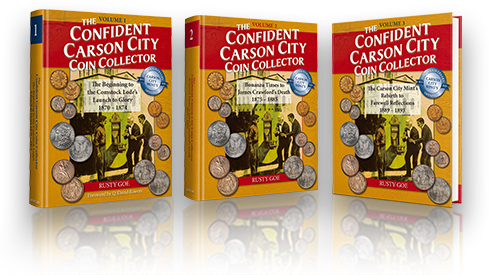
The Confident Carson City Coin Collector
by Rusty Goe
The Carson City Mint’s celebrated legacy — replete with landmark achievements, setbacks, mysteries and tall tales — is covered in exacting detail in Goe’s three-volume set.
by Rusty Goe
The Carson City Mint’s celebrated legacy — replete with landmark achievements, setbacks, mysteries and tall tales — is covered in exacting detail in Goe’s three-volume set.
Auction Info
2025 February 27 - March 2 Long Beach Expo US Coins Signature® Auction #1381 (go to Auction Home page)
Auction Dates
Feb-Mar, 2025
27th-2nd
Thursday-Sunday
Bids + Registered Phone Bidders: 86
Lot Tracking Activity: N/A
Page Views: 3,223
Buyer's Premium per Lot:
20% of the successful bid per lot.
Shipping, Taxes, Terms and Bidding
Terms and Conditions | Bidding Guidelines and Bid Increments | Glossary of Terms | US & World Coin Grading Tutorial
Important information concerning Sales Tax and Resale Certificates. Learn More
Terms and Conditions | Bidding Guidelines and Bid Increments | Glossary of Terms | US & World Coin Grading Tutorial