
LOT #3550 |
Sold on Aug 24, 2022 for: Sign-in
or Join (free & quick)
1876-CC 20C MS65 PCGS. BF-NC-1, R.6.. ...
Click the image to load the highest resolution version.
Sold on Aug 24, 2022 for:
$870,000.00
Bid Source: Live: Floor bidder
Description
1876-CC Twenty Cent Piece, MS65
Celebrated Branch Mint Rarity
Only 16 Examples Traced
1876-CC 20C MS65 PCGS. BF-NC-1, R.6.Ex: Bender Collection. Called the "Duke of Carson City Coins" by Rusty Goe, the 1876-CC twenty cent piece is a sought-after 19th century rarity. Traditionally, the 1876-CC has been considered a numismatic prize of the first order, in the same rarity class as the famous 1804 dollar, 1838-O half dollar or the 1894-S dime. Heritage Auctions is pleased to offer a spectacular Gem example of this famous Western rarity in just its third auction appearance.
Origins of the Twenty Cent Piece
The twenty cent piece was authorized by the Act of March 3, 1875, with the full support of Mint Director Henry Linderman. While making change for everyday purchases was not a problem in the eastern part of the country, where all coinage denominations were readily available, a shortage of five cent coinage in the western regions led to frequent overcharging by merchants whose customers paid for their purchases with a quarter. Although the overcharging was well-documented in earlier times, it probably became more acute after 1873, when the half dime denomination was discontinued. Silver half dimes had been coined regularly by the San Francisco Mint to serve the regional economy, while the base-metal five cent nickels were only struck in Philadelphia. The twenty cent piece was a well-meaning attempt to solve this longstanding problem. Much has been said about the role of influential mine owners seeking to expand the silver market but, in The Confident Carson City Coin Collector, Rusty Goe makes a convincing argument that their influence was minimal in establishing the twenty cent piece.
An Unpopular Denomination
Unfortunately, the odd denomination was doomed from the start. If the Mint had discontinued the quarter when it introduced the twenty cent piece, the new denomination might have been successful, but they continued to produce the two denominations side-by-side, causing much confusion. Mint policy in the 19th century insisted on uniformity of design on the 90% silver denominations, with only rare exceptions, like the Morgan dollar. The obverse of the twenty cent piece employed the long-lived Seated Liberty design, also in use on the contemporary dime, quarter, and half dollar. The reverse portrayed an eagle that closely resembled the bird on the Trade dollar reverse. The specifications called for a diameter of 22 mm, extremely close to the 24.3 mm diameter of the quarter, making the two denominations almost indistinguishable at a quick glance. The coins were frequently confused with each other during transactions, resulting in the same kind of overcharging the denomination was supposed to prevent in the first place. In more recent times, a similar situation was created with the Susan B. Anthony dollar, which shows how difficult it is to learn from past mistakes where money is concerned. The twenty cent piece was universally unpopular and the denomination was retired from circulation after 1876, although the Philadelphia Mint continued to strike proofs until 1878.
The 1876-CC Twenty Cent piece in the 19th Century
On January 8, 1876, the Carson City Mint Cashier still had 4,261 twenty cent pieces from the previous year in his stock, enough to cover commercial demand for some time. Accordingly, the Carson City Mint struck only a modest production of 10,000 twenty cent pieces in 1876. Virtually all of the reported mintage was stored in vaults at the Western facility, because the coins were not wanted in circulation. On May 19, 1877, Mint Director Linderman sent this message to Superintendent James Crawford in Carson City:
"You are hereby authorized and directed to melt all 20-cent pieces you have on hand, and you will debit 'Silver Profit Fund' with any losses thereon."
The great majority of the 1876-CC mintage was immediately destroyed per these instructions, along with many leftover coins from 1875.
Fortunately, a few examples of the 1876-CC did reach circulation before Linderman's order was issued. For example, John Seagraves Peck, a "Forty-Niner" who later made his way to Nevada after the Comstock Lode was discovered, acquired at least one specimen, allegedly from a friend at the Mint, in 1876. He retained the coin throughout his life, and passed away in April 1890, just three months after the first auction appearance of an 1876-CC twenty cent piece took place. Peck's coin was treated as an heirloom by his family, and it remained in his descendants' possession until it was auctioned by Bowers and Merena in June 2009. The coin was graded AU58 by PCGS. At least three more circulated examples have surfaced over the years, indicating some other coins must have escaped in this manner, but not many have survived.
The first auction appearance of an 1876-CC twenty cent piece was in lot 1506 of the R.C. Davis Sale (New York Coin & Stamp, 1/1890). Appropriately placed in the section of the catalog labeled Fifth Dollars or Twenty Cent Pieces, the coin was described as, "1876-CC mint: sharp, brilliant, uncirc. We know of no duplicate of this mintage." The lot realized a relatively strong price of $7, possibly to prominent collector William H. Woodin.
A few years later, Augustus Heaton popularized collecting branch mint issues through his influential 1893 work A Treatise on the Coinage of United States Branch Mints. Heaton paid special attention to the 1876-CC, mentioning it in his preface and the main body of the book, where he noted:
"The pieces of 1876-CC have become very rare, as we noted in our preface, from the negligence of Western collectors, or the indifference of all to Mint Mark rarities."
Apparently, Heaton was not aware of the destruction of most of the 1876-CC mintage in 1877. He believed the issue had been depleted over the years by the usual process of wear and attrition in circulation. Linderman's memo ordering the destruction of the stored mintage, the real cause of the rarity of the 1876-CC, was only discovered in the early 1960s, by researcher Walter Thompson.
By 1894, at least three specimens were known to collectors, as reported in the June issue of The Numismatist. At least one more auction of an 1876-CC twenty cent piece took place in the 19th century, in lot 216 of the Simeon L. Lee Collection (Scott Stamp & Coin, 6/1899). Lee was a wealthy doctor and a resident of Carson City. His coin was an Uncirculated example and we assume he acquired it directly from the Carson City Mint in 1876. The lot realized a substantial price of $26.25, to prominent collector John M. Clapp. It later passed into the fabulous collections of Louis E. Eliasberg and Eugene Gardner, and is graded PCGS MS64 today
The 1876-CC in Later Years
By the dawn of the 20th century, at least five examples of the 1876-CC twenty cent piece were known to the numismatic community, as revealed by Edouard Frossard when he cataloged an example in lot 324 of his sale of the J.G. Hubbard Collection in December 1900:
"1876 C.C. mint. Obv. Uncirculated; rev., proof surface. Very rare. Only five known."
The lot realized another record price of $28, to S. Benton Emery. Emery's family preserved the coin until it was sold in a Bowers and Merena sale in 1984. It is currently graded PCGS MS66.
One of the great unexplained mysteries of the 1876-CC is the high quality of most of the survivors. Like the Lee-Clapp-Eliasberg and Hubbard-Emery specimens that were discovered so early, most of the coins we know about today are attractive, high-grade pieces. By law, a number of coins from each year's mintage were set aside for examination by the Assay Commission in Washington, D.C. Naturally, the coins selected tended to be high-quality specimens that would impress the examiners with the craftsmanship of the issuing facility. It has been suggested that the bulk of survivors represent untested specimens that were preserved by members of the Assay Commission, and we suspect at least some of the coins are from this source. However, Rusty Goe points out that the number of Uncirculated survivors probably exceeds the number of coins that would be sent to the Assay Commission for a mintage of 10,000 pieces. There was virtually no numismatic interest in branch mint issues before Heaton published his book in 1893. It would be extremely unusual for collectors to mail order a number of high-grade examples from a remote mint like Carson City in 1876, before the mintage was destroyed. As unlikely as it seems, a number of local Carson City residents, like Dr. Simeon Lee and John Seagraves Peck, must have acquired a few coins for their novelty value and preserved them for future generations.
The population of known examples increased slowly after the turn of the century, with only one or two more examples surfacing over the next 50 years. Then, in the late 1950s, the number of survivors expanded considerably when Baltimore dealer Tom Warfield discovered a group of splendid Uncirculated examples in a Maryland estate. The original owner of this remarkable hoard has never been identified, but it has been suggested that he was a member of the Assay Commission in 1877 and set these coins aside for posterity. The exact number of pieces in the Maryland Hoard has not been firmly established, with estimates from different sources varying from five to 10 pieces.
Of course, prices for the 1876-CC have increased exponentially from the early days of the 20th century, when a collector like S. Benton Emery could purchase one of the finest known examples for $28. The current record price realized for an 1876-CC is $564,000, realized by a PCGS MS65 specimen in a Stack's Bowers auction in 2013. We expect the upward trend to continue for the foreseeable future.
How Many 1876-CC Twenty Cent Pieces are Extant
PCGS and NGC have combined to certify 23 coins between them, but that total certainly includes an unknown number of resubmissions and crossovers (7/22). PCGS CoinFacts more conservatively estimates the surviving population at 20 examples in all grades. Rusty Goe provides a detailed roster of 17 examples known to him on pages 214-215 of his book. Studying the images from our sale of the NGC MS64 specimen in the Rian's Bequest Collection in January 2022, which were not available to Rusty when he conducted his study, we believe coins number 8 and 13 in his roster are actually the same specimen. Comparing the color plate of coin number 13 in the Auction '80 catalog to the image of the Belle-Rian's Bequest example in our 2022 catalog, we note the following similarities between the coins:
Both examples show a thin, curving scratch in the left obverse field, from Liberty's arm to near star 4.
Both specimens exhibit a dark round color spot between R and I in AMERICA.
Both coins have a tiny diagonal scratch across the upright of the I in AMERICA, near the base.
We believe these similarities demonstrate that coins 8 and 13 are the same, reducing the roster to 16 pieces. Rusty notes that only a maximum of five example from his roster could have come from the Maryland Hoard, since the other coins have provenances that predate its discovery. If the hoard actually did include more than five examples, as some sources suggest, there may still be a few more hoard specimens that have been moving outside of numismatic channels and escaped detection since their discovery, but that seems most unlikely. Altogether, 16 survivors seems like the best estimate.
The Present Coin
We suspect the coin offered here is one of the survivors from the Maryland Hoard, but we can only definitively trace its history back to a Bowers and Ruddy Fixed Price List of July 1979. It next appeared in lot 1405 of the 400 Sale (Stack's, 1/1988), and recently surfaced in lot 5182 of the ANA Convention Auction (Stack's Bowers, 8/2019), where it realized $456,000.
This delightful Gem exhibits the lustrous, appealing original surfaces that characterize the coins from the Maryland Hoard. Both sides are lightly toned in attractive shades of silver-gray, with a few highlights of olive and russet in selected areas. Softly frosted mint luster shines through the patina, adding to the outstanding eye appeal. No mentionable distractions are evident on either side. The design elements are well-detailed, with just a touch of the usual softness on Liberty's head and the eagle's left (facing) wing. This coin possesses an irresistible combination of absolute rarity, intense historic interest, and terrific visual appeal. It should find a home in the finest collection or Registry Set. The 1876-CC is listed among the 100 Greatest U.S. Coins. This coin is pictured on PCGS CoinFacts. Population: 4 in 65, 2 finer (7/22).
Ex: Fixed Price List (Bowers and Ruddy, 7/1979); 400 Sale (Stack's, 1/1988), lot 1405; Horatio Morgan Collection/ANA Convention Auction (Stack's Bowers, 8/2019), lot 5182, realized $456,000.
From The Bender Family Collection, Part I. (Registry values: N1)
Coin Index Numbers: (NGC ID# 23R9, PCGS# 5300, Greysheet# 5041)
Weight: 5.00 grams
Metal: 90% Silver, 10% Copper
View all of [The Bender Family Collection, Part I ]

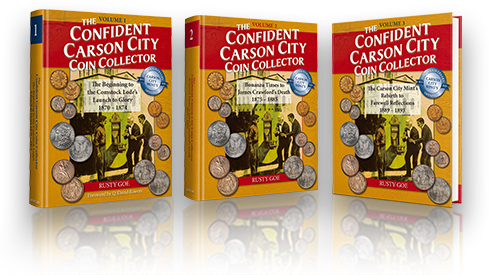
The Confident Carson City Coin Collector
by Rusty Goe
The Carson City Mint’s celebrated legacy — replete with landmark achievements, setbacks, mysteries and tall tales — is covered in exacting detail in Goe’s three-volume set.
by Rusty Goe
The Carson City Mint’s celebrated legacy — replete with landmark achievements, setbacks, mysteries and tall tales — is covered in exacting detail in Goe’s three-volume set.
Auction Info
2022 August 22 - 28 US Coins Signature® Auction #1348 (go to Auction Home page)
Auction Dates
August, 2022
22nd-28th
Monday-Sunday
Bids + Registered Phone Bidders: 57
Lot Tracking Activity: N/A
Page Views: 3,660
Buyer's Premium per Lot:
20% of the successful bid per lot.
Shipping, Taxes, Terms and Bidding
Terms and Conditions | Bidding Guidelines and Bid Increments | Glossary of Terms | US & World Coin Grading Tutorial
Important information concerning Sales Tax and Resale Certificates. Learn More
Terms and Conditions | Bidding Guidelines and Bid Increments | Glossary of Terms | US & World Coin Grading Tutorial